














































Renewable energy now employs at least 16.6 million people worldwide, up from 7.3 million in 2012, according to the International Renewable Energy Agency and International Labour Organization’s Renewable Energy and Jobs: Annual Review 2025. Solar power alone has grown into the single largest employer among all renewable technologies, its footprint roughly matching wind, hydropower and biofuels combined. This is not a future trend. It is already among the fastest-growing employment categories worldwide, and most young people in Doha have never been told what that means for them.
Most coverage of the energy transition stays at the level of capital, targets and geopolitics. Which country invests how much, which summit sets which deadline, which minister signs which deal. That coverage matters, but it skips the layer that affects a young person deciding what to study or where to build a career, and rarely asks what kind of engineer, technician or analyst this shift needs, or by when.
This piece stays on that layer: what the data actually says, and what it means for youth in Doha and across the region, using figures from IRENA, the ILO, the WEF, and the UN Economic and Social Commission for Western Asia (ESCWA). No slogans, no assumptions about what young people should care about — just the numbers, and what they add up to.
The Global Shift
Renewable jobs do not appear evenly around the world. They follow capital. China remains the dominant hub for renewable manufacturing and installation employment, accounting for roughly 7.3 million jobs, or about 44 percent of the global total, according to the IRENA–ILO review, because that is where governments and utilities have committed the most money to actually building capacity. Jobs in this sector are a direct output of construction, not sentiment or ambition.
Solar photovoltaic work alone accounts for more jobs than any other renewable technology tracked in the same review, a shift that happened inside roughly a decade. That speed matters — industries that grow this fast tend to hire faster than universities can build matching degree programmes, which means openings for those willing to specialise early rather than wait for a fully formed career track.
That is the pattern worth understanding before looking at any single country’s numbers. Wherever governments commit capital and utilities sign contracts to build, engineering, installation, commissioning and long-term operations jobs follow, in that order and on a fairly predictable schedule. The global total of 16.6 million people already working in renewables is not a ceiling. It is the floor set by the countries that have already broken ground. The next question is simple. Is this region one of them.
None of this includes this region automatically. Capital has to be committed, contracts signed, and construction actually started. The good news is that it has already begun here.
The Skills Turn
It is. But the jobs available in five years will not look identical to the jobs available today, because the skills employers want are shifting fast, faster than most degree curricula are built to track. The World Economic Forum’s Future of Jobs Report 2025 projects that 22 percent of today’s jobs globally will be transformed between 2025 and 2030, meaning 170 million roles created and 92 million displaced, for net growth of 78 million. On average, workers should expect 39 percent of their current skill set to change or become outdated within that same five years.
For the first time, environmental stewardship made the report’s list of the ten fastest-growing skills worldwide. Renewable energy engineers, environmental engineers, and electric and autonomous vehicle specialists now rank among the fifteen fastest-growing job roles globally, sitting alongside AI and data specialists rather than trailing behind them. That placement is the detail worth sitting with. This is no longer being treated as a secondary or niche specialisation. It sits in the same tier of urgency as artificial intelligence, which says something about how seriously employers expect this shift to reshape hiring over the next few years.
None of this is an entirely new field for the region. Mechanical, electrical and civil engineering already exist in local universities and technical institutes. What has changed is which specialisation inside those disciplines employers are hiring for, and how quickly that demand is moving from planning documents into real job postings.
Consider what that looks like in practice. A mechanical engineering graduate in Doha has always had a route into oil and gas. That route has not closed. But a parallel route, into solar plant design, battery storage systems, or grid integration, now carries the same institutional weight in global hiring data. The choice is no longer between a traditional path and a speculative one — both are now documented, tracked and growing.
The Regional Opening
The Arab region has already tripled its solar and wind capacity, from 6.8 GW to 22.9 GW between 2018 and 2023, driven largely by expansion in Saudi Arabia, the UAE and Jordan, according to ESCWA’s 2024 report, Investing in the Future: The Role of Human Capital in Enabling Just Energy Transitions in the Arab Region. By installed capacity share, Egypt, the UAE and Morocco currently hold the largest positions in the region. The GCC is expected to invest close to USD 100 billion in low-carbon energy by 2030, and most Gulf states have adopted net-zero targets for mid-century. The region also holds some of the strongest solar conditions anywhere on Earth, an advantage that becomes more valuable, not less, as technology costs keep falling.
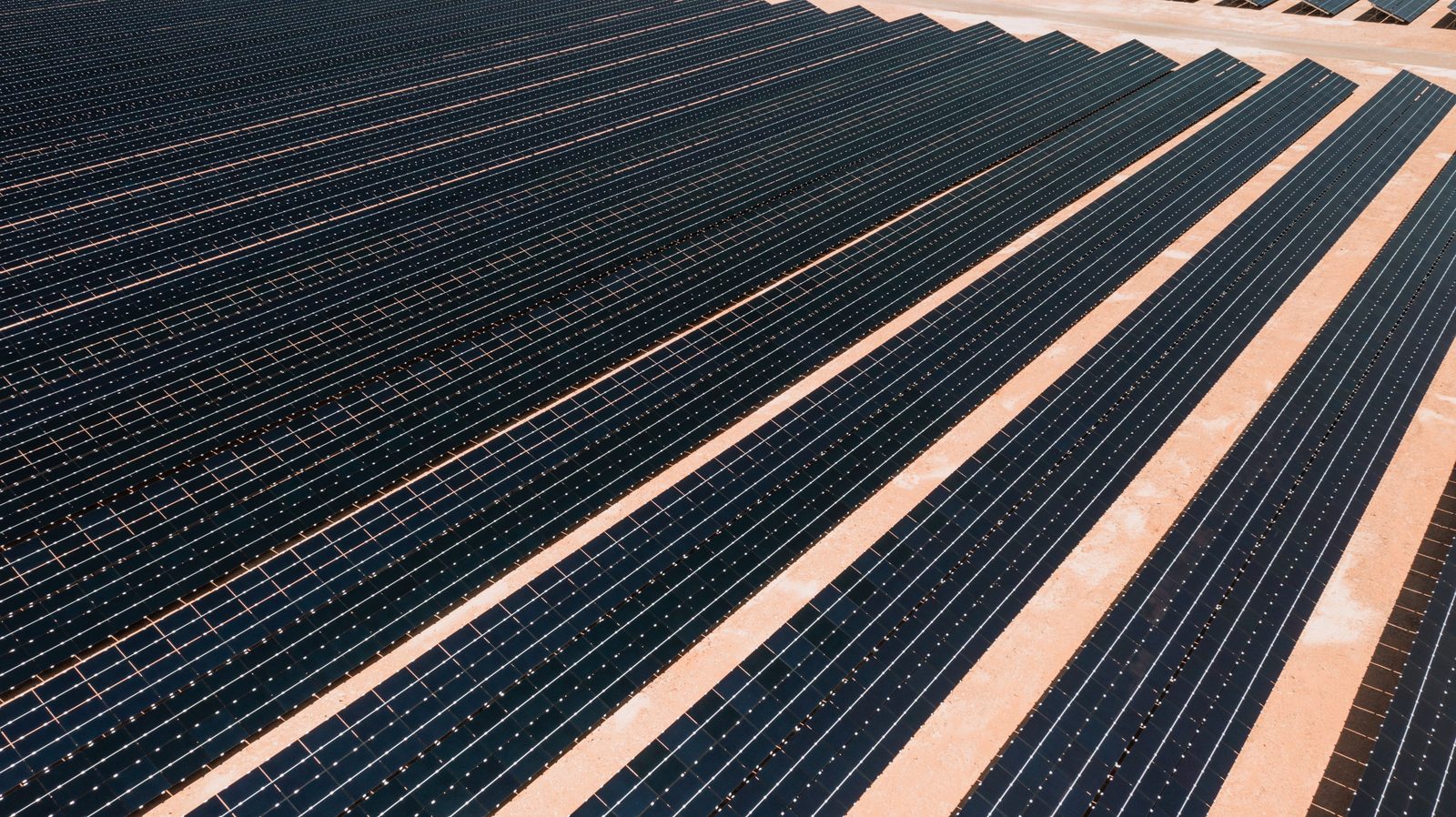
Qatar is part of this build-out. Kahramaa’s National Renewable Energy Strategy targets around 4 GW of new large-scale renewable capacity and roughly 18 percent of the national power mix from renewables by 2030, up from about 5 percent when the strategy launched. QatarEnergy’s Dukhan solar project is expected to reach 2,000 MW of total capacity by mid-2029, built across two phases, and stands as one of the clearest examples of what this regional shift looks like on the ground here.
Numbers like these translate directly into jobs, at every stage of the build. Engineering and design happen before construction starts. Procurement and project management run through the build itself. Installation and commissioning follow as capacity comes online in stages. Then operations and maintenance carry the project for the two to three decades it typically runs. ESCWA’s own modelling puts a figure on the wider regional opportunity this creates: active regional engagement in the transition could generate 6.6 million jobs across the Arab region by 2050, rising to close to 10 million with added investment in climate resilience. Those are not distant numbers. They describe the exact kind of work a Doha-based engineer, technician or analyst could be doing inside this decade.
This pattern is not unique to Qatar. Saudi Arabia, the UAE and Jordan are running comparable build-outs of their own, which is exactly how the region’s combined solar and wind capacity tripled in five years. Each project needs the same occupational mix in roughly the same sequence, which means a skill set built around one Gulf project transfers easily to the next.
This is happening on our timeline, not someone else’s.
Why It’s a Youth Story
Here is the part of this story that rarely gets said out loud. This is happening on our timeline, not someone else’s. Close to 58 percent of the Arab region’s population is under the age of 30, according to ESCWA. A student starting an engineering degree in Doha this year will graduate around the same time Qatar’s 2030 renewable targets and the Dukhan project’s completion are due. Someone a few years into a first job now will be reaching real seniority on that same horizon, right as the region’s biggest renewable projects move from construction into long-term operation.
That timing is not automatically in our favour. It has to be earned, and it will not last indefinitely. ESCWA’s own reporting indicates sustainable energy ranks among the sectors young people across the region express strong interest in working in, so a lack of interest does not appear to be the problem. What respondents said was actually missing is access: to relevant training, to internships tied to real projects rather than generic placements, and to a visible route connecting a technical degree to an actual entry-level job in the sector.
One factor worth naming honestly. The IMF’s October 2025 Regional Economic Outlook for the Middle East and Central Asia notes that regional economies have shown resilience so far in 2025, but that continued regional geopolitical tensions and still-elevated global uncertainty remain a downside risk to the near-term outlook. Large-scale energy projects are long-horizon commitments, and periods of regional escalation can weigh on financing decisions, procurement cycles, and construction schedules. That does not close the window described above, but it is a real hurdle to meeting these expectations on the current timeframe, and it belongs in any honest reading of it.
A young region entering the workforce at the exact moment a new industry is scaling up is a genuine advantage, but only for as long as the skills pipeline keeps pace with it. Once the current wave of projects comes fully online, the hiring surge behind them tends to slow. That is the honest way to read this window: real, currently open, and not permanent.
Put another way: a region with one of the youngest populations in the world is entering the workforce at precisely the moment a brand-new industrial sector needs people. That kind of alignment does not happen often, and when it does, it rarely announces itself as clearly as this one has.
The Shaper Take
So what does this mean for someone deciding what to study or where to specialise next. Three things stand out. Technical literacy in generation, storage and grid systems, because that is where the physical build is happening right now, not five years from now. Data and digital skills, because monitoring and optimising a build-out at this scale is a data job as much as it is an engineering one. And sustainability-specific expertise, which the World Economic Forum now ranks alongside AI and cybersecurity rather than beneath them, a signal worth taking seriously when choosing a specialisation.
What makes this moment different from earlier waves of regional investment is timing. The completion dates on real, named projects, Dukhan among them, land in the same years this region’s youngest workers are meant to be hitting their stride professionally. That alignment will not always hold. Right now, it does.
That is what makes this a youth story. Not what the transition means in the abstract, but what it means for a specific decision a specific person here is making about their next five years.
- International Renewable Energy Agency and International Labour Organization — Renewable Energy and Jobs: Annual Review 2025
- World Economic Forum — Future of Jobs Report 2025
- UN Economic and Social Commission for Western Asia — Investing in the Future: The Role of Human Capital in Enabling Just Energy Transitions in the Arab Region (2024)
- Kahramaa — National Renewable Energy Strategy Accessed July 2026
- QatarEnergy — Dukhan Solar Project, announced September 2024
- International Monetary Fund — Regional Economic Outlook: Middle East and Central Asia, October 2025